
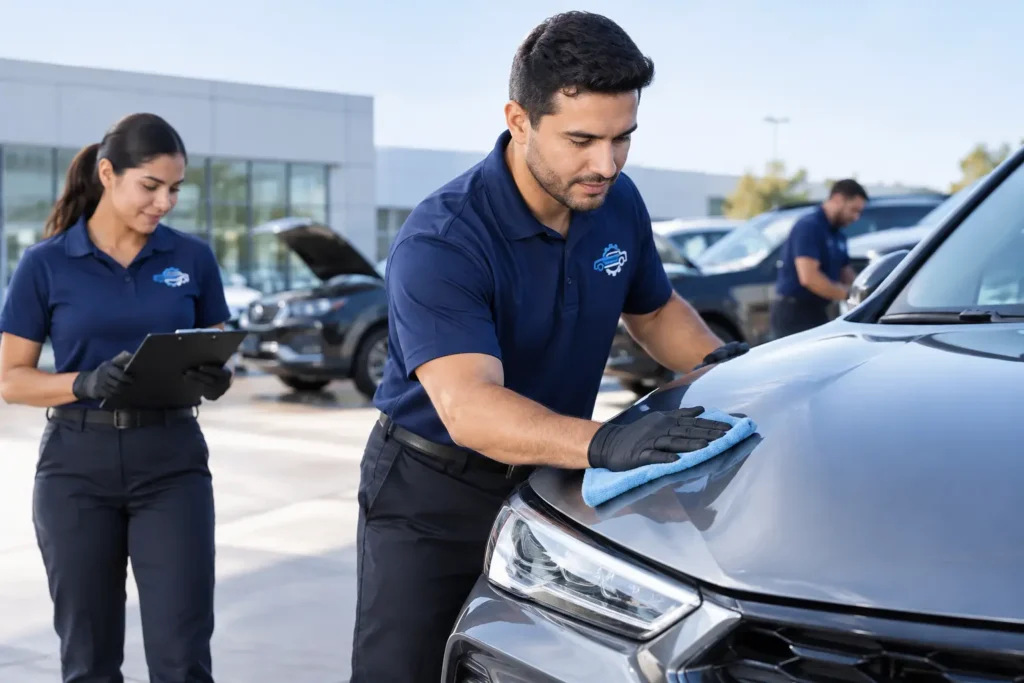
A used vehicle does not become profitable when it is acquired. It becomes profitable when it is front line ready, priced correctly, merchandised, and available for a customer to buy. Automotive get ready is the operating discipline that determines how quickly that happens. When the process runs on whiteboards, paper jackets, phone calls, and memory, cars sit. Every additional day adds holding cost, depreciation exposure, and another chance for a retail-ready unit to be overlooked.
The issue is rarely that a dealership lacks people who know how to inspect, repair, detail, or photograph a vehicle. The issue is that no one has a reliable, real-time view of the entire path from acquisition to the sales line. A car may be waiting on an estimate, a part approval, a vendor pickup, a wash bay, or photos. If that wait is not visible, it is not being managed.
Automotive Get Ready Is a Management Process
Get-ready is often treated as a service or detail department responsibility. That view is too narrow. It is a dealership-wide process with handoffs between used-car management, service, parts, body shop, detail, vendors, photography, merchandising, and sales. Every handoff creates an opportunity for delay, especially when the next person has to hunt for information or wait for someone to return a call.
A GM or Dealer Principal should be able to answer a few questions without assembling a meeting: Which vehicles are not front line ready? How long have they been in process? What stage are they in? What is holding them up? Who owns the next action?
If those answers depend on asking several managers, the store does not have control of its reconditioning process. It has a collection of departmental updates. Those are not the same thing.
That which is measured improves. A timestamped get-ready workflow turns broad complaints such as “service is slow” or “detail is backed up” into something management can act on. It may show that mechanical repair is moving quickly but vehicles are waiting two days for repair authorization. Or that parts are ordered promptly, but no one is alerted when they arrive. The bottleneck is not always where people assume it is.
The Cost of a Car That Is Almost Ready
The most expensive used vehicle may be the one that is 90 percent complete and invisible. It has already consumed acquisition dollars, transport, inspection time, repair labor, and perhaps parts. Yet it is not online, not on the lot, and not available to sell.
A vehicle waiting for one final task can quietly become a seven-day delay. Maybe it needs a windshield appointment, a paintless dent repair vendor, a final detail, or photos. Without clear ownership, each department assumes someone else is handling it. The vehicle remains marked as “in process” while its aging clock keeps running.
Holding cost is only part of the damage. Delayed frontline availability reduces selection for the sales team and can force a dealership to rely more heavily on aged inventory. It also weakens pricing decisions. A manager may price a vehicle based on the day it was acquired, then discover that market conditions shifted before the car ever reached the lot.
The answer is not to rush repairs or skip needed work. Cutting corners can create a bad retail experience, higher recon expense later, and avoidable customer problems. The goal is to remove idle time between legitimate tasks. A quality process and a fast process can coexist when every task has an owner, a status, and a deadline.
Build the Process Around Real Handoffs
A workable automotive get-ready process begins at intake, not when a technician first touches the vehicle. The vehicle should enter the workflow as soon as the dealership has responsibility for it, whether it came from a trade, auction, lease return, or wholesale source.
At intake, the store needs the basic facts: stock number, VIN, source, location, acquisition date, target frontline date, and the person accountable for moving the unit through the process. From there, the workflow should reflect how the dealership actually operates.
For one store, inspection may lead directly to mechanical work, parts, detail, photos, and merchandising. Another may need bodywork, outside vendors, emissions work, glass, keys, or title-related steps before the vehicle can be cleared. There is no value in forcing every dealership into the same sequence. There is real value in making the chosen sequence visible and consistent.
Make the Next Step Unmistakable
Status labels such as “in service” or “getting ready” are too broad to drive action. They describe the car’s general condition, not the work required to move it. Better stages identify the next operational handoff: awaiting inspection, awaiting estimate approval, awaiting parts, in mechanical repair, awaiting vendor, in detail, awaiting photos, or ready for merchandising.
Each stage needs one accountable owner. Accountability does not mean blaming the person assigned when another department has created the delay. It means there is no ambiguity about who must push the next action forward, document the obstacle, and escalate when necessary.
A useful rule is simple: if a manager sees a vehicle sitting in a stage, the dashboard should show why it is there and what must happen next. “Waiting” is not an explanation. Waiting for what, from whom, and since when?
Use Timestamps to Separate Facts From Opinions
Reconditioning conversations can become emotional quickly. Service may feel used cars send work over late. Used-car managers may feel repair orders disappear into the shop. Detail may feel vehicles arrive without enough notice. Vendors may say they were never contacted.
A shared, timestamped record removes guesswork. It documents when a vehicle entered a stage, when work was assigned, when a vendor was notified, when a part was ordered, and when the task was completed. This is not about creating more paperwork. It is about replacing verbal status reports with facts.
Management reporting should focus on the vehicles and stages that require attention. Average cycle time is useful, but averages can hide serious problems. A store could have an acceptable average while several desirable units have been stuck for ten days. Review the outliers: units past target date, vehicles idle in a stage, and tasks without a current owner.
The same reporting can identify repeat patterns. If multiple vehicles stall after inspection, the store may need faster estimate approvals. If detail is consistently overloaded on certain days, scheduling or staffing may need adjustment. If outside work is the issue, vendor expectations and response times may need to be documented more clearly.
Communication Must Be Part of the Workflow
Text messages and phone calls will always have a place in dealership operations. They are useful for urgent questions and quick coordination. They are not a dependable system of record for vehicle status.
When critical work lives in individual text threads, managers cannot see whether the message was sent, whether the vendor responded, or whether the vehicle was completed. The process becomes dependent on the memory and availability of specific people. That is a risk when employees are off, busy, or no longer with the dealership.
A centralized dashboard gives departments and vendors one place to work from. Service can update completed repairs. Parts can record an arrival or delay. Detail can see the next vehicle coming their way. Used-car management can approve work without chasing paper. Sales can see which units are close to the line. The information is shared, but responsibilities remain clear.
AutoGetReady is built for this exact dealership reality: configurable stages, real-time vehicle status, timestamped activity, alerts, vendor communication, and reporting that shows where the process is slowing down. The point is not to impose a generic workflow. The point is to expose the delays inside the workflow your store already uses and give management the information to correct them.
Set Standards Before You Demand Speed
A faster process starts with clear expectations. Define the target cycle time from acquisition to front line ready, then set reasonable stage targets based on the type of work involved. A clean late-model trade should not follow the same timeline as a high-mileage unit requiring mechanical repair, bodywork, and parts.
Standards should be firm but realistic. If management sets targets that ignore capacity, parts availability, or vendor schedules, employees will learn to treat them as meaningless. Start by measuring current performance, identify the longest idle periods, and improve the process in practical steps.
Review get-ready performance regularly with the managers who own each stage. The meeting should not become a roundtable of explanations. Focus on exceptions, root causes, and decisions. Which vehicles need escalation today? Which task is aging without movement? What decision is preventing the car from reaching the line?
A dealership does not need more noise around reconditioning. It needs a process that makes stalled work impossible to ignore. When every vehicle has a current stage, a documented next step, and a named owner, get-ready stops being a daily scavenger hunt. It becomes a controllable path to more front line-ready inventory and faster opportunities to retail it.